
Introducing our newest charity recommendations—from mobile contraceptive clinics to digital mental health care

Introducing our newest recommended ideas
We are excited to share four new charity ideas recommended for the September 2026 cohort of the Charity Entrepreneurship Incubation Program.
Over the second half of 2025, we evaluated a range of interventions aimed at improving health and wellbeing in low- and middle-income countries (LMICs). This round focused in particular on two broad areas:
improving access to essential health services where delivery systems remain weak, and
addressing large, persistent gaps in care or prevention that lead to avoidable suffering or poor life outcomes.
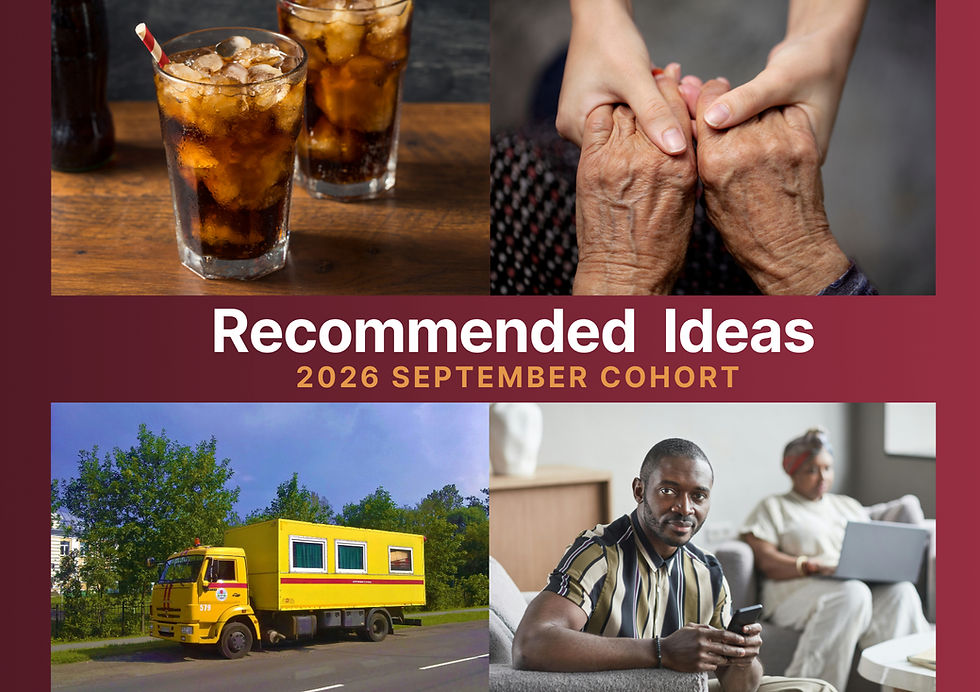
The resulting recommendations span several sectors and approaches. They include expanding access to modern contraception through mobile clinics; improving access to pain relief for people in palliative care in LMICs; delivering guided digital self-help for depression; and policy advocacy to reduce the health burden of sugar-sweetened beverages.
Across these ideas, the common thread is tractability. Each intervention addresses a well-evidenced problem, has a clear path to implementation, and shows potential to deliver meaningful impact at scale. Short summaries of each recommendation are provided below, with full reports linked. We are grateful to the many external experts who contributed their time and insights to this research, as well as to the AIM Research Program fellows who supported this round: Aliaa Shanab, Anirudh Anilkumar, Christopher Clifford, Eugenia Brotons Batista, Goodness Ogeyi Odey, Joel Christoph, Koen Schoenmakers, Kunal Peety, Maria Pinto Teixeira, Nithya Srinivasan, Nzube Ifediba, Samuel Mazzarella, and Shaileen McGovern.
Please note that we expected more ideas to be recommended before the program state date (2026 September). At this stage, we estimate one policy-oriented idea and one direct delivery global health and development idea.
Reducing diet-related disease through taxes on sugary drinks
High consumption of sugary drinks is a major contributor to type 2 diabetes, cardiovascular disease, and poor oral health worldwide. Intake has risen over recent decades, driven by increased affordability and availability. Evidence shows that taxes on sugar-sweetened beverages can reduce consumption and, in some cases, encourage manufacturers to reformulate products to contain less sugar.
This idea focuses on advocating for and supporting the introduction of the WHO-recommended 20% excise tax on sugary drinks. A new charity would work on policy advocacy and implementation support in countries where such taxes are absent or weak, with the aim of reducing consumption and lowering the overall burden of diet-related disease.
Improving access to pain relief for people with serious illness
Across much of the world, people with severe pain still lack access to effective pain relief. While high-income countries face challenges related to opioid overuse, many LMICs experience the opposite problem: widespread undertreatment of pain. This gap, often described as the global “opioid access abyss,” leaves millions without adequate pain management.
The proposed charity would work to reduce this gap by improving access to opioid medications for people with serious illness, starting with palliative care in LMICs. Its work would focus on three linked areas: policy reform, education of healthcare workers and the public, and supply-chain strengthening. Together, these activities aim to remove structural barriers to care and support safe, sustainable access to pain relief in settings where it is currently limited.
Improving access to depression care through guided self-help
Depression is one of the leading causes of disability worldwide, affecting more than 300 million people. The burden falls disproportionately on LMICs, where large treatment gaps persist: the WHO estimates that around 75% of people who need care receive none. Guided self-help offers a promising way to address this gap. By combining evidence-based psychological support with light human guidance, these programs can reach large numbers of people at low cost and expand access to care in settings where mental health services are scarce.
This idea focuses on delivering a digital guided self-help program for adults with depression in LMICs, modeled on the WHO’s Step-by-Step program and informed by the implementation approach used by Kaya Guides, a mental health nonprofit previously incubated by AIM.
Expanding access to contraception through mobile clinics
Millions of women in LMICs want to delay or avoid pregnancy but lack access to reliable contraceptives. Common barriers include long travel distances to health facilities, frequent stockouts, limited method choice, and weak health system capacity. These constraints are particularly acute in rural and hard-to-reach areas, where use of modern contraception remains low despite high unmet need.
This idea focuses on expanding access to contraception through mobile clinics that bring care directly to underserved communities. These clinics would provide same-day services, including long-acting methods, alongside counseling and follow-up care. While mobile outreach is already used by several large providers, coverage remains uneven, creating scope for a well-targeted organization to expand access in high-need locations in a cost-effective way.
Apply to our program to help launch these organizations
We encourage you to learn more about these ideas here and register for the upcoming Q&A sessions, where you will have the opportunity to have your questions answered by our program, research and recruitment team.

Curious about nonprofit entrepreneurship? Hear directly from our founders about what inspired them to take the leap.
Unfamiliar with our program? The Charity Entrepreneurship Incubation Program is a free 2-month training program that helps you bring an evidence-based idea for a new charity, a talented co-founder to build a new organization with, and up to $200,000 in seed funding. We have successfully incubated over 50 charities, reaching 75+ million people and 1+ billion animals. Learn more about our track record and what it’s like to be on the program.


Excellent and eye‑opening post! These four evidence‑backed charity ideas address huge, under‑served health gaps across low‑ and middle‑income countries. It’s inspiring to see both direct‑service solutions and policy‑advocacy paths highlighted for the incubation program. Kudos to your whole research team and contributing experts for this thorough round of analysis. This is incredibly useful reading for anyone exploring high‑impact nonprofit entrepreneurship! --RNGdle
일자리를 구할 때 밤알바 단순히 근무 가능 여부만 확인하기보다 장기적으로 생활 패턴과 잘 맞는지도 생각해야 할 것 같습니다. 밤알바는 낮 시간을 활용할 수 있다는 특징이 있어 개인 일.정이 많은 사람에게 도움이 될 수 있겠네요. 업무 내용과 급여 지급 방식, 휴게 시간까지 확인하면 보다 안정적으로 근무 계획을 세울 수 있습니다
The mobile contraceptive clinic idea stood out to me since so many women in rural areas can't reach regular care. I also found War of Genesis: Idle Loot Wiki while reading through the reports, which helped me understand the health topics better. Curious to see which ideas get picked for the 2026 cohort.
friday night funkin challenges players to maintain perfect timing while keeping up with increasingly fast and difficult musical performances.
Spent way too long on Poki last weekend — started with one puzzle game and ended up trying like five different ones. Everything loads right in the browser which is nice when you just want something quick without installing anything. The variety is honestly what keeps me coming back.